
Running may seem like a solo sport, but ultramarathons are inherently a team effort. Behind every runner is a community of crew, pacers, volunteers, and fellow athletes fighting toward the same goal. For you to achieve something hard.
Wolverine State 100 was no exception. We suffered, fought, and celebrated together. It was my first 100-miler race, and it certainly won’t be my last. Here is the story of my adventure across northern Michigan.
Course & Pre-Race Setup

Wolverine State 100 is a point-to-point ultramarathon across Michigan, stretching from Lake Michigan in Petoskey to Lake Huron in Alpena. From great lake to great lake.
The course features a mix of singletrack, unimproved roads, crushed limestone, and paved roads. It has a little bit of everything, all rolled into one unique race.
Our race began at 5:30 a.m. at Bayfront Park in Petoskey. There were 218 of us.
Mile 0-19: Pavement, Sand & A Winch Rescue
The first 8 miles took us through Petoskey and along hilly, paved roads. My favorite part about this section was looking ahead and seeing all the flashing safety lights, and looking behind to see all the headlamps. It was quiet and peaceful.
Just before mile 8 and the first aid station, we began a 600-foot climb up Skyline Trail. This is the largest climb on the course and the most difficult. In fact, most of the elevation for Wolverine State 100 is in the first 50K of the race.

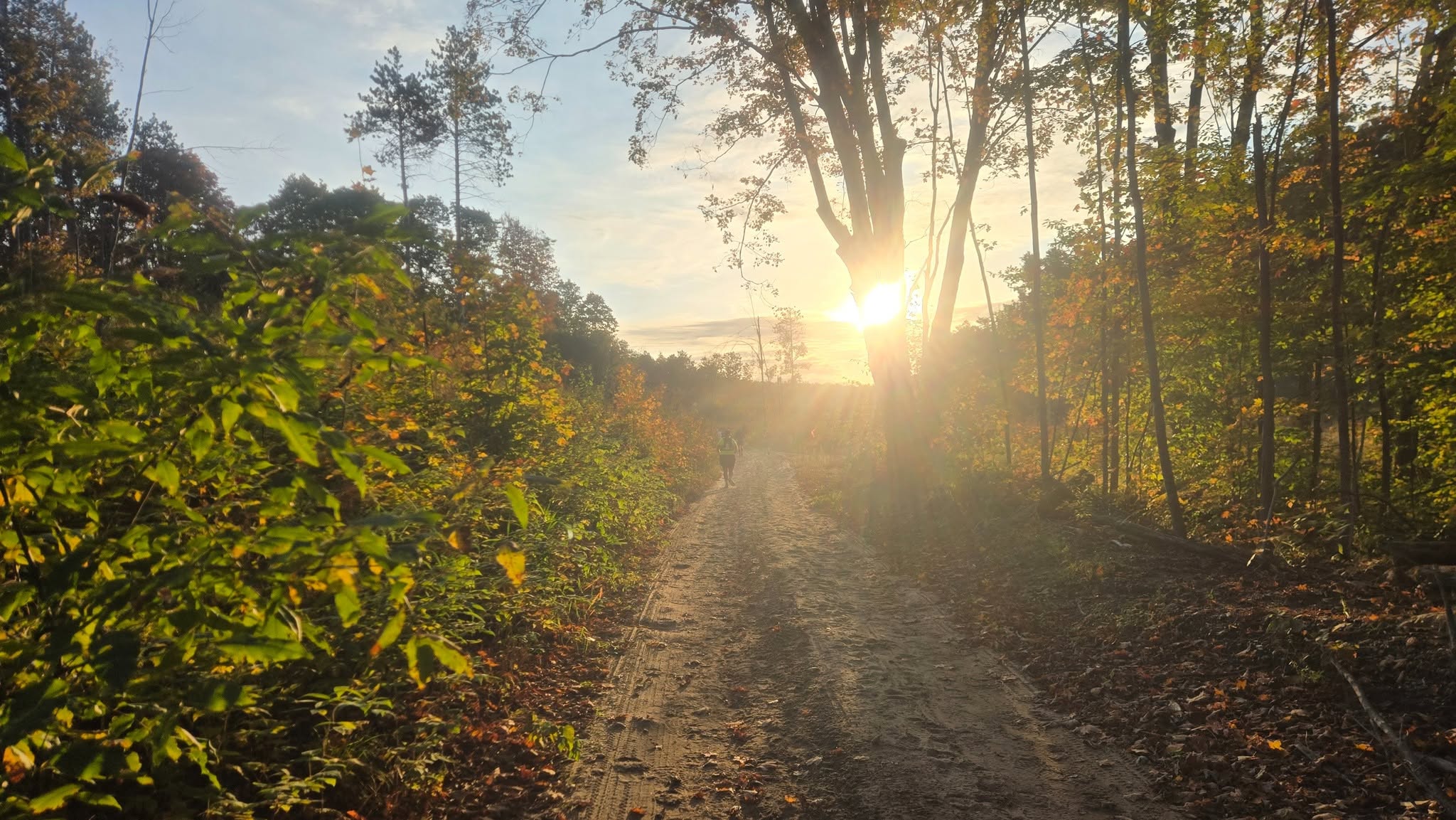
After reaching the top of Skyline Trail, I was greeted by the morning sun and, with it, some very pretty views. Although the largest climb was out of the way, the course still had more to throw at us. The next 10 miles were full of rolling hills, sandy singletracks, and narrow unimproved roads.

I ran into my first challenge at aid station #2, mile 16.7. I arrived ahead of schedule. My crew truck was nowhere to be found. Someone told me that a vehicle had gotten stuck up the road, completely blocking access to the aid station. He said I shouldn’t count on my crew and should get taken care of at the aid station. Just as I started to figure out what I needed, Steve pulled up. He had used his winch on his truck to pull the stuck vehicle free, opening the road and making it to me just in time.

He got me refueled and sent me on my way.
Miles 19-29: Battling Heat & Migraine
Going into this race, I was prepared that there would be sections that I didn’t enjoy. This was one of them.

The course left behind the dirt road and dropped us onto a main, paved road. With daytime temperatures pushing 80F, radiating asphalt, and no shade whatsoever, I started to struggle. My head was throbbing as a migraine began to settle in, and I was starting to overheat.
I stopped briefly at aid station #3 (mile 25.3) to grab some pierogies and was eager to get off the hot pavement. My mistake here was that I didn’t start soaking my hat and shirt in cool water. The pavement continued for another 4 miles.
Miles 29-53: High Country Trail, Stomach Disasters, & Henry the Dog
This section is why I signed up for Wolverine State. Pigeon River State Forest.

The course switched to forest dirt roads, but the shade was still limited. Aid station #4 (mile 33), I was going to see my crew again and pick up my first pacer. I sent Steve a text ahead of time to let him know I was struggling with the heat. I power-hiked with another runner who was struggling. By this point, my stomach had started to turn and was more of an issue than the head pain itself.
I shuffled into the aid station. Steve was ready. He gave me ice, put cooling mats on me, and had fans going. While he emptied and repacked my vest, he gave me a tums to try to help my stomach. It immediately came back up. For the first time ever during an ultra, I threw up. I didn’t know what to do.
My pacer got me up and we started moving. Over the next 8 miles, I battled vomiting and nausea. My pacer did her best to help keep me moving. Other people offered aid and words of encouragement. But when we reached aid station #5 at mile 40, I thought I was done.

I sat on the ground, slowly sipping Vernors and nibbling potato chips (some of which I shared with the sweet aid station dog, Henry). This reset worked. After about 15 minutes, I was on my feet, feeling almost 100%, and ready to go back into the woods.

We lost an hour over the course of those 8 miles. Darkness was coming, and we were 6 miles away from our lights. We picked up the pace, got into a rhythm, and made it just as the sun dipped below the horizon.
As night set in, the cool air helped me fully recover, and the forest came alive with the calls of the Barred Owl and bugling elk. That was the experience I was looking forward to the most.
Miles 53-76: Middle of Nowhere & the 4 A.M. Grind
At mile 54.8, we entered aid station #7. This would be the last opportunity for the crew to see their runners for nearly 14 miles. With temperatures starting to dip, and with it being over the half way point of the race, I decided to change into entirely fresh clothes and added an additional long pant and shirt layer on. We also did a light check to make sure everything was working properly before my pacer and I headed off into the darkness.
For almost the entire next 13 miles, we navigated the High Country Pathway. We passed other runners who were struggling and runners who were having a lovely time. We continued pushing, quietly through the forest with the bright, cloudless sky full of stars above us.
By the time we reached aid station #9 at mile 67, my feet were starting to feel sore. I opted to switch into my more cushioned road shoes earlier than I expected. I’m glad I did because the next 10-mile stretch was flat asphalt.
The pavement was mentally grueling and felt like it was never going to end. I realized that we were moving too slowly and losing too much time in aid stations, so I started to push myself harder. In doing so, I accidentally dropped my pacer. At mile 74.2, I stopped at aid station #10 to wait for my pacer to catch up. While waiting, I enjoyed resting by a cozy campfire, eating some noodles, and petting a shy dog named Elvis. Pulling away from that warm fire took pure willpower.
Merely 3.5 miles later, though, I reached the crew truck. Steve had the heat blasting and warm blankets ready. Steve refilled my vest, gave me a light jacket, and despite my protests, kicked me out of the truck and back into the night.
Miles 78-102: A New Day & The Sprint to the Finish
About an hour after leaving aid station #11 (and the comfort of the truck), daylight broke, bringing with it new energy. I was lucky enough to briefly see a small group of elk before they disappeared back into the woods.
I realized yet again how close I was to the race cutoff. I wasn’t going to make it. The next 7 miles were spent on a flat, grassy section surrounded by wetlands on the Alpena Hill Trail. I dug in and picked up the pace, dropping my pacer for the final time.
After what felt like an endless amount of miles, I reached mile 85 and aid station #12, where my second pacer was already heading out to find me. He had new, fresh energy and was eager to help me finish my race.
Steve made a surprise stop at the aid station as well. He, being a great crew chief, figured it was getting warmer and that I would want to drop all of my extra layers and lights. He was correct.


We ran on roads for a short distance before hopping back onto the endless Alpena Hill Trail. My pacer kept me moving, and we were dropping minutes from my time every mile.
At mile 90.5, we made our final scheduled crew stop for ice, potato chips, and coke. Only 11.5 miles to go. We moved out of the aid station quickly.
The trail shifted to crushed limestone gravel and remained very flat. My feet were hurting. The hard surface didn’t feel good beneath them, even with my cushioned shoes. Despite being mentally and physically strong, I was ready to be done.
We kept moving forward at a faster-than-expected pace and continued cutting the minutes off.
At the two-mile mark, we left the Alpena Hill Trail and entered downtown Alpena. I immediately started looking for the finish line. Locals cheered from their porches, telling us we were doing a great job. Panic started to set in. Time was running out and I still didn’t know where the finish line was. A few locals yelled out that we had about a mile to go. The final cutoff was 15 minutes away.
I didn’t think I was going to finish. My pacer said we should run a little. We started and didn’t stop. It felt surprisingly good to run. It would feel better when I could see the finish line.
We followed sign after sign saying “turn here” before we finally saw it. “Bay View Park”. The finish line was out on a pier in Lake Huron. The wind picked up. I ran faster.


With just under 8 minutes to spare, I crossed the finish line. I had completed my first 100-mile ultramarathon.
What I Learned

There was a lot to learn over the course of 102 miles. Here are my top takeaways.
I need to be more direct with pacing. I need to speak up if something isn’t working.
I’m more mentally resilient than I thought I was. I kept a sharp mindset over the 100 miles and proved to myself that I can handle far more mentally than I thought.
I wasn’t lacing my shoes correctly. I’ve now switched to “window lacing” to avoid laces crossing over the top of my foot and putting pressure on my nerves and tendons.
I can come back from stomach disasters. I need 10 to 15 minutes to pause, drink Vernors, and get some salt back into my system.
I held back too much during the middle miles and had too much energy left at the finish. I needed to push myself harder during the second half of the race, specifically the last 30 miles.
Final Thoughts
I learned so much from this experience. Wolverine State 100 is an excellent first 100-mile race. It built confidence that I can complete the distance.
I was considering returning in 2027 because things didn’t go the way I had hoped, but after reflecting, I’ve decided that I would rather run a different race. There were so many sections of Wolverine State that just weren’t for me. My goal for my next one is to have a lot more trail in it.
Shout-out to my crew, pacers, the Trivium Racing staff, and the volunteers who kept all the runners moving, myself included. You are what helps make these races memorable and special.
While I won’t be returning, it is safe to say that Wolverine State will always have a special place in my heart.


Leave a Reply